
Ask your data. On-premise.
An AI assistant for Power BI: a small language model on your own hardware, a semantic catalogue and a deterministic DAX builder. Private, controlled, with no data sent to the cloud.
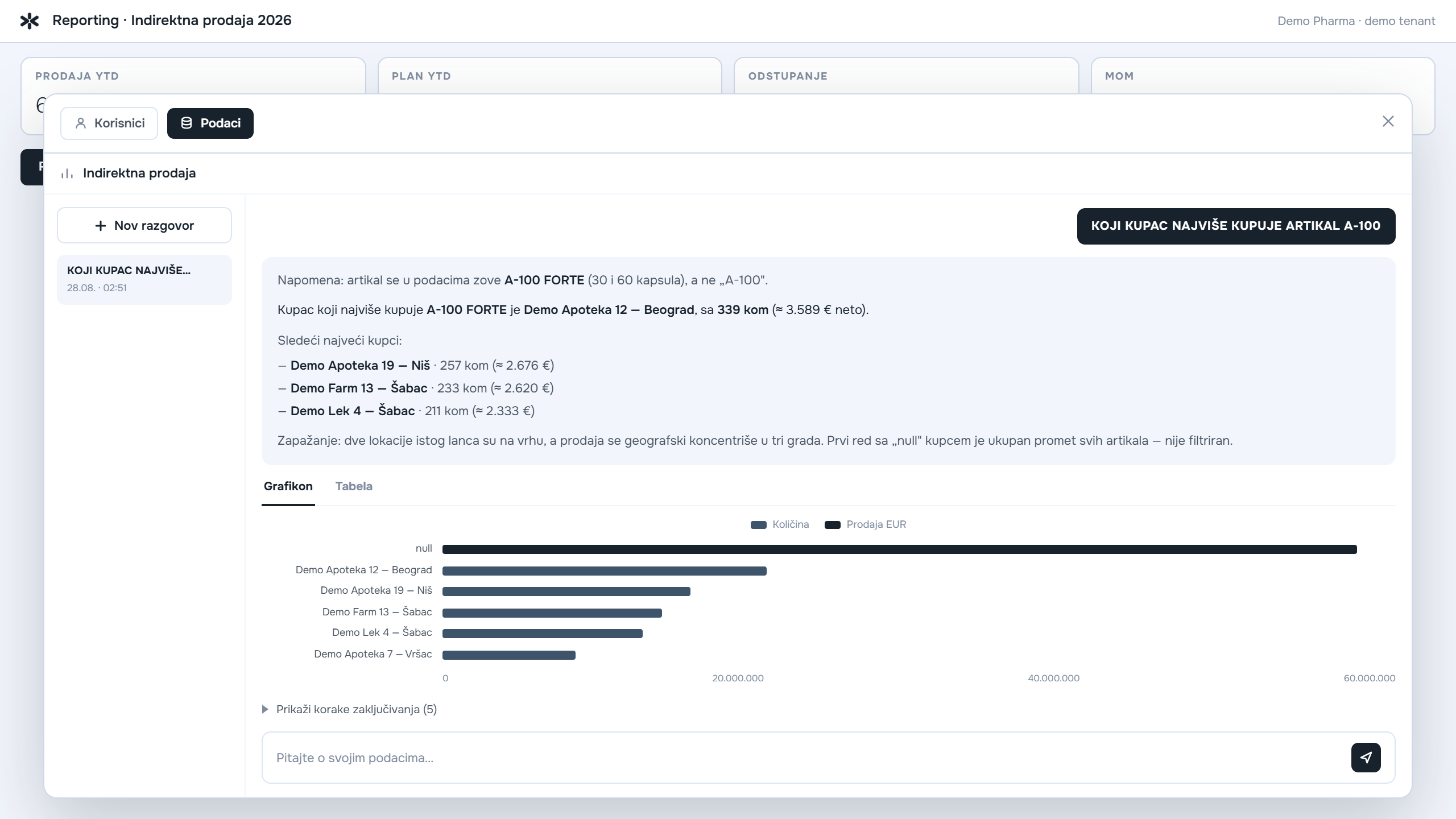
Prikaz demo okruženja sa izmišljenim podacima. Nijedan podatak klijenta nije prikazan.
From question to answer — with no cloud.
The key idea: the AI does not write DAX directly. It generates a structured query plan, and a deterministic builder builds, validates and executes the DAX — predictable, testable and easy to audit.
A question in plain language
“Show revenue by month for 2025.” — the user asks as they would ask a person, not a database.
The local model builds a plan
A small Llama model (8B–14B) on your hardware classifies the intent and returns a structured JSON query plan — not DAX.
Semantic catalogue
The layer you know, not the LLM: synonyms, certified measures, relationships and constraints. This is where the difference between “sales” and [Revenue] lives.
Deterministic DAX builder
The backend builds the DAX from the plan and the catalogue using fixed templates, and validates it. The same question always yields the same DAX.
Execution on your own model
The XMLA endpoint or the Execute Queries API — respecting RLS rules and your existing access management.
Answer and explanation
The assistant explains the result over the actual numbers — it does not invent them, and it does not reach into the model on its own.
Privacy, control and predictable costs.
With small models and a structured query plan, you do not need a large server — or someone else's cloud.
Privacy
Data and metadata do not leave your environment. Not one query token goes to a public LLM cloud.
Control and audit
You own the catalogue, the DAX templates and the guardrail rules. Every query is logged and auditable.
Lower costs
With an on-premise setup there is no per-token billing — fixed hardware and a predictable monthly inference cost, on the stable XMLA standard. Cloud agents are billed per use.
A fixed-scope POC: five phases to a Go/No-Go decision.
30–40 person-days, three senior experts, one Power BI dataset and a core set of queries. Every phase has clear inputs, outputs and an acceptance criterion — at the end you get a recommendation for production.
Analysis and catalogue
Analysis of your Power BI model and building the business glossary: synonyms, measures, relationships, rules and constraints.
Pipeline and integration
The local model and the query plan, the deterministic DAX builder, and integration with your environment over XMLA.
Evaluation and report
Accuracy measured on the core set of queries, and a report with a recommendation for production — you decide with numbers.
Prove the concept on your own model.
A fixed-scope POC on one of your Power BI datasets — at the end you get measured accuracy and a Go/No-Go recommendation for production.
Request a POC quote